Skip to content

Free US shipping · 20% off, applied automatically

Science

What is methylene blue?

Where it comes from, what researchers have found, what remains unknown, and who shouldn’t take it. Every source is linked.

How it works

Focus and energy depend on your cells' power plants

Every thought and every step runs on ATP, an energy molecule made inside tiny structures in your cells called mitochondria. The brain is one of the most energy-hungry organs in the body, which is why researchers pay close attention to how brain cells make and use energy.

How your cells make energy, simplifiedElectrons from food pass through complex I, CoQ10, complex III, cytochrome c and complex IV to oxygen, which powers ATP synthase to make ATP. Methylene blue can carry electrons from complex I directly to cytochrome c.Methylene blueIIIIIVQ10cATPFoodOxygen= energy
Simplified. Real mitochondria have many more parts.
  1. 1

    Food becomes electrons

    As you digest food, your cells draw electrons from it.

  2. 2

    Electrons pass along a chain

    Protein complexes I, III and IV pass them along like a relay. CoQ10 and cytochrome c carry them between stations.

  3. 3

    The flow makes ATP

    This flow powers ATP synthase, which makes ATP, the energy your cells run on.

  4. 4

    Where methylene blue fits

    Methylene blue can accept electrons and pass them directly to cytochrome c. Researchers describe this as a shortcut that may help the chain keep running.[1]

Meet methylene blue

A 150-year-old compound, newly understood

Methylene blue isn’t a new discovery. It was first made in 1876 and is often called the first synthetic drug. What is new is research into how it relates to cellular energy.

  1. 1876

    First made as a dye

    Heinrich Caro, a chemist at BASF in Germany, first made methylene blue as a dye for cotton.[2]

  2. 1880s

    A tool for seeing cells

    Robert Koch and Paul Ehrlich used dyes like it to stain cells and microbes so they could be studied under the microscope.[2]

  3. 1891

    An early step in modern medicine

    Paul Guttmann and Paul Ehrlich reported using it against malaria. It is often described as the first synthetic drug.[3]

  4. 20th century

    A starting point for later discoveries

    Its chemistry went on to inform whole families of later medicines, and it remained a standard laboratory stain.[4]

  5. 2000s to today

    Research into cellular energy

    Researchers began studying how low doses of methylene blue interact with the energy chain inside mitochondria.[1]

Why such a small amount

Research suggests methylene blue can have different effects at low and high doses, a pattern scientists call a hormetic dose response.[5] Each NueBlū formula uses a small, measured amount: 14 mg per daily serving in Refocus and 10 mg in Recharge and Restore.

Why capsules instead of drops

Liquid methylene blue is difficult to measure precisely, and it stains the mouth, teeth and sink. A capsule gives you the same measured amount every day, with no taste and no mess.

Why it isn’t for everyone

Methylene blue can interact with antidepressants and other serotonergic medicines. The FDA has warned about this interaction, mostly in hospital use of intravenous methylene blue.[6] People with G6PD deficiency should not take it either.[7] Read the full safety notes

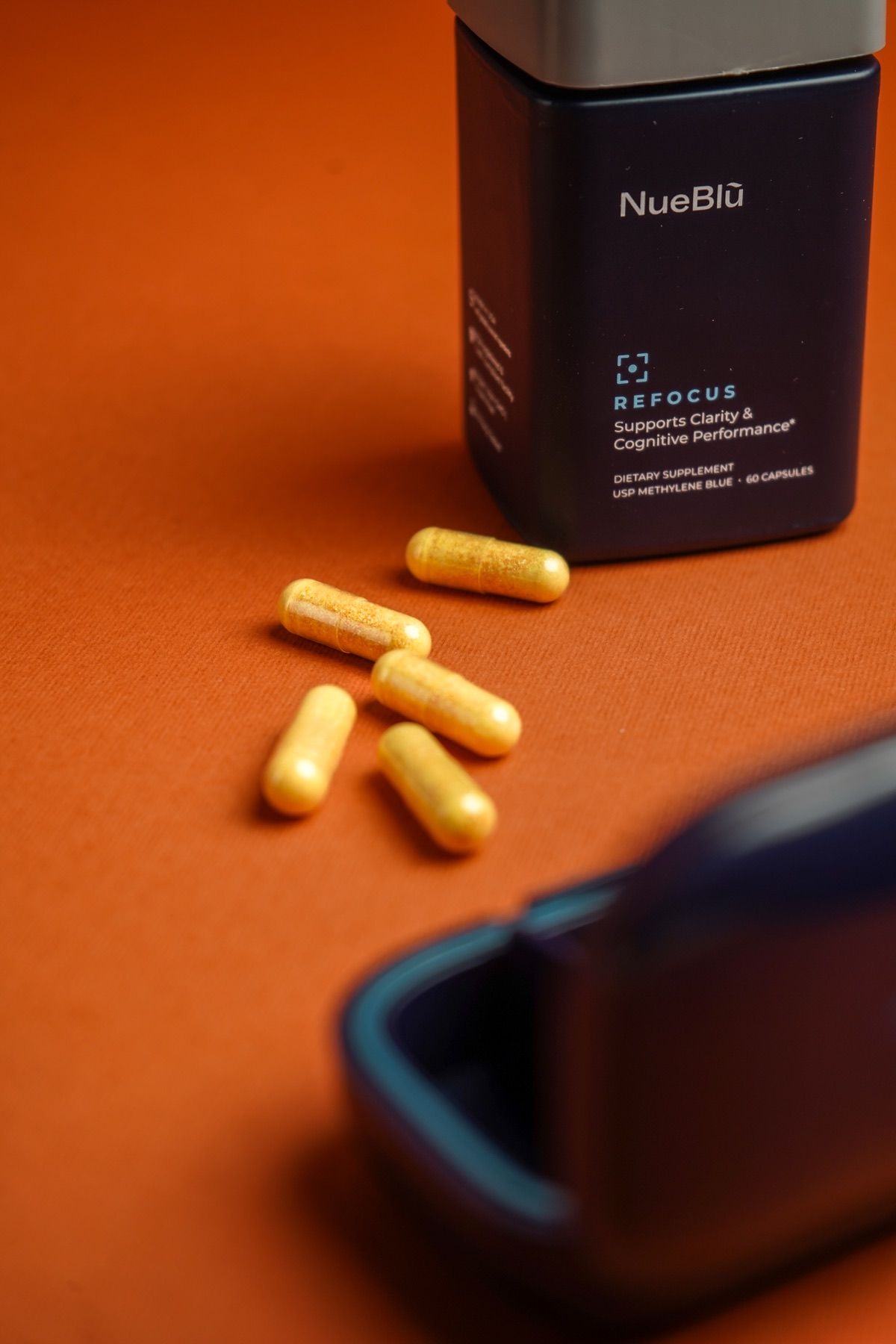
Refocus capsules next to the jar label showing Methylene Blue USP

What the research shows, and what it doesn’t

What we know

  • Laboratory research describes how methylene blue can carry electrons along the mitochondrial energy chain.[1]
  • In a randomized, placebo-controlled brain-imaging study of 26 healthy adults, a single dose was followed by more activity in brain regions linked to attention and memory, and better short-term memory scores.[8]

What we’d like you to know

  • That study used a single 280 mg dose, about 20 times the daily amount in Refocus, so its results can’t be assumed for a daily supplement.
  • Much of the research on how methylene blue works comes from laboratory and animal studies.
  • NueBlū formulas themselves haven’t been tested in clinical trials. That’s why each formula pairs methylene blue with ingredients that have their own human research.

Safety

Who shouldn’t take methylene blue

How NueBlū uses it

Three formulas, each with a small, measured amount

  • Refocus

    Focus and clarity

    14 mg methylene blue per day, with Bacopa monnieri, Suntheanine® L-Theanine.

    Learn about Refocus →
  • Recharge

    Steady energy

    10 mg methylene blue per day, with Sensoril® Ashwagandha, Panax ginseng, Coenzyme Q10.

    Learn about Recharge →
  • Restore

    Antioxidant support

    10 mg methylene blue per day, with N-Acetyl-L-Cysteine, Quercetin anhydrous, Vitamin C.

    Learn about Restore →

The research behind each formula

Refocus: the research behind each ingredient

What each daily serving of Refocus contains, and what researchers have observed in people who took these ingredients.

300 mg

Bacopa monnieri extract (whole plant)

A traditional Ayurvedic herb studied for memory over twelve weeks of daily use.*

In research

Delayed word recall and attention scores improved compared with placebo.[9]

Study:
Randomized, double-blind, placebo-controlled trial
Who:
48 adults aged 65 and over, average age 73
Dose studied:
300 mg a day
How long:
12 weeks

The extract was standardized differently from ours. The most common side effect was stomach upset.

In research

Learning new words and recalling them later improved compared with placebo.[10]

Study:
Randomized, double-blind, placebo-controlled trial
Who:
81 adults over 55
Dose studied:
300 mg a day
How long:
12 weeks

A different bacopa extract from ours. Participants reported more digestive side effects than with placebo.

200 mg

Suntheanine® L-Theanine

An amino acid found in tea leaves, studied for calm alertness and attention.*

In research

Sleep quality scores improved compared with placebo. Stress-related scores and some measures of attention improved during the L-theanine period.[11]

Study:
Randomized, placebo-controlled crossover trial
Who:
30 healthy adults, average age 48
Dose studied:
200 mg a day of Suntheanine®, the same form and amount as Refocus
How long:
4 weeks

Cognitive changes were not significant against placebo overall. The ingredient maker supplied the product and employs two of the authors.

In research

A single dose shortened reaction time on attention tasks and improved working-memory accuracy.[12]

Study:
Randomized, placebo-controlled trial
Who:
69 adults aged 50 to 69
Dose studied:
About 100 mg a day
How long:
12 weeks, plus single-dose tests

Half the amount in Refocus. Twelve weeks of daily use did not change attention scores.

14 mg

Methylene Blue USP

A compound researchers study for its role in how cells produce energy. Each daily serving contains a small, measured amount.*

See Meet methylene blue on this page for how it works, why we use a small amount and what the research does and doesn’t show.

These studies tested the ingredients, not NueBlū formulas, and results in studies don’t guarantee individual results.

Refocus

$53.60$67Save 20%Introductory price · 30-day supply · about $1.79 a day
More about Refocus

Recharge: the research behind each ingredient

What each daily serving of Recharge contains, and what researchers have observed in people who took these ingredients.

300 mg

Sensoril® Ashwagandha (Withania somnifera, root and leaf)

An adaptogenic herb studied for how the body responds to everyday stress.*

In research

Perceived stress scores fell compared with placebo at all three doses, and more at the higher doses.[13]

Study:
Randomized, placebo-controlled trial
Who:
98 adults, average age 35
Dose studied:
125, 250 or 500 mg a day of Sensoril®
How long:
8 weeks

Funded by the ingredient maker. Participants were younger than most of our customers.

200 mg

Panax ginseng extract (stem and leaf)

A traditional root studied for mental performance during demanding tasks.*

In research

The 200 mg dose improved mental arithmetic and reduced self-rated mental fatigue during demanding tasks.[14]

Study:
Randomized, placebo-controlled crossover trial
Who:
30 healthy young adults
Dose studied:
200 or 400 mg (G115 extract)
How long:
Single doses

One-off doses of a different extract, in young adults.

In research

Some aspects of thinking improved in some trials, but the reviewers found no convincing overall evidence of cognitive enhancement in healthy people.[15]

Study:
Cochrane systematic review of 9 randomized trials

We include this review for balance.

100 mg

Coenzyme Q10 (CoQ10) USP

Your cells use CoQ10 to turn food into energy.*

In research

CoQ10 levels in most human organs peaked around age 20 and declined steadily with age.[16]

Study:
Laboratory analysis of human and animal tissue
Who:
Human organs from ages 1 day to 81 years

This study measured tissue levels. It did not test supplements.

10 mg

Methylene Blue USP

A compound researchers study for its role in how cells produce energy. Each daily serving contains a small, measured amount.*

See Meet methylene blue on this page for how it works, why we use a small amount and what the research does and doesn’t show.

These studies tested the ingredients, not NueBlū formulas, and results in studies don’t guarantee individual results.

Recharge

$50.40$63Save 20%Introductory price · 30-day supply · about $1.68 a day
More about Recharge

Restore: the research behind each ingredient

What each daily serving of Restore contains, and what researchers have observed in people who took these ingredients.

300 mg

N-Acetyl-L-Cysteine (NAC)

A building block the body uses to make glutathione, one of its main antioxidants, which plays a role in normal immune function.*

In research

NAC supplies cysteine, a building block the body needs to make glutathione, one of its main antioxidants.[17]

Study:
Scientific review

In research

Glutathione levels and markers of oxidative stress improved compared with placebo.[18]

Study:
Randomized, placebo-controlled trial
Who:
24 adults aged 61 to 80
Dose studied:
Glycine plus NAC, 100 mg per kg of body weight each, daily
How long:
16 weeks

NAC was combined with glycine, at roughly 25 times the amount in Restore.

250 mg

Quercetin anhydrous (from Sophora japonica)

A plant flavonoid with antioxidant properties.*

In research

Quercetin is one of the most common antioxidants in the diet, and in laboratory studies it neutralizes several reactive molecules.[19]

Study:
Scientific review

Mostly laboratory research.

100 mg

Vitamin C (as ascorbyl palmitate)

An essential antioxidant vitamin.*

10 mg

Methylene Blue USP

A compound researchers study for its role in how cells produce energy. Each daily serving contains a small, measured amount.*

See Meet methylene blue on this page for how it works, why we use a small amount and what the research does and doesn’t show.

These studies tested the ingredients, not NueBlū formulas, and results in studies don’t guarantee individual results.

Restore

$48.80$61Save 20%Introductory price · 30-day supply · about $1.63 a day
More about Restore

Questions

Common questions

What is methylene blue?

Methylene blue is a compound first made in 1876. Researchers have studied it for its role in how cells produce energy inside the mitochondria. NueBlū uses a small, measured amount per daily serving: 14 mg in Refocus and 10 mg in Recharge and Restore, alongside well-known ingredients such as L-theanine, CoQ10 and NAC.

Is it safe for me?

It isn’t right for everyone, which is why we list the exceptions clearly. Please do not take NueBlū if you take antidepressants or other serotonergic medicines (SSRIs, SNRIs, MAOIs, some pain and migraine medicines, St. John’s Wort or 5-HTP), if you have G6PD deficiency, or if you are pregnant, nursing or under 18. If you take any prescription medicine, check with your doctor first.

Will it turn anything blue?

Your urine may look blue or green. This is expected and harmless. It’s simply the methylene blue leaving your body.

How long until I notice anything?

Everyone is different, so we don’t promise a timeline. Many of our ingredients were studied over several weeks of daily use. We suggest taking it every day with food for the full 30 days of one jar before you decide.

Is this a subscription?

No. A one-time order is one jar with one payment. Nothing renews automatically.

Sources

References

  1. 1.Rojas JC, Bruchey AK, Gonzalez-Lima F. Neurometabolic mechanisms for memory enhancement and neuroprotection of methylene blue. Prog Neurobiol. 2012;96(1):32–45. PubMed
  2. 2.Oz M, Lorke DE, Hasan M, Petroianu GA. Cellular and molecular actions of methylene blue in the nervous system. Med Res Rev. 2011;31(1):93–117. Full text
  3. 3.Schirmer RH, Adler H, Pickhardt M, Mandelkow E. “Lest we forget you--methylene blue...” Neurobiol Aging. 2011;32(12):2325.e7–16. PubMed
  4. 4.Yang SH, Li W, Sumien N, et al. Alternative mitochondrial electron transfer for the treatment of neurodegenerative diseases and cancers: methylene blue connects the dots. Prog Neurobiol. 2017;157:273–291. Full text
  5. 5.Bruchey AK, Gonzalez-Lima F. Behavioral, physiological and biochemical hormetic responses to the autoxidizable dye methylene blue. Am J Pharmacol Toxicol. 2008;3(1):72–79. PubMed
  6. 6.US Food and Drug Administration. Drug Safety Communication: Updated information about the drug interaction between methylene blue (methylthioninium chloride) and serotonergic psychiatric medications. October 20, 2011 (archived). FDA (archived)
  7. 7.PROVAYBLUE (methylene blue) injection, prescribing information. Revised January 2024. Contraindications: G6PD deficiency. FDA label
  8. 8.Rodriguez P, Zhou W, Barrett DW, et al. Multimodal randomized functional MR imaging of the effects of methylene blue in the human brain. Radiology. 2016;281(2):516–526. Full text
  9. 9.Calabrese C, Gregory WL, Leo M, et al. Effects of a standardized Bacopa monnieri extract on cognitive performance, anxiety, and depression in the elderly: a randomized, double-blind, placebo-controlled trial. J Altern Complement Med. 2008;14(6):707–13. Full text
  10. 10.Morgan A, Stevens J. Does Bacopa monnieri improve memory performance in older persons? Results of a randomized, placebo-controlled, double-blind trial. J Altern Complement Med. 2010;16(7):753–9. PubMed
  11. 11.Hidese S, Ogawa S, Ota M, et al. Effects of L-theanine administration on stress-related symptoms and cognitive functions in healthy adults: a randomized controlled trial. Nutrients. 2019;11(10):2362. Full text
  12. 12.Baba Y, Inagaki S, Nakagawa S, et al. Effects of L-theanine on cognitive function in middle-aged and older subjects: a randomized placebo-controlled study. J Med Food. 2021;24(4):333–341. Full text
  13. 13.Pandit S, Srivastav AK, Sur TK, et al. Effects of Withania somnifera extract in chronically stressed adults: a randomized controlled trial. Nutrients. 2024;16(9):1293. Full text
  14. 14.Reay JL, Kennedy DO, Scholey AB. Single doses of Panax ginseng (G115) reduce blood glucose levels and improve cognitive performance during sustained mental activity. J Psychopharmacol. 2005;19(4):357–65. PubMed
  15. 15.Geng J, Dong J, Ni H, et al. Ginseng for cognition. Cochrane Database Syst Rev. 2010;(12):CD007769. PubMed
  16. 16.Kalén A, Appelkvist EL, Dallner G. Age-related changes in the lipid compositions of rat and human tissues. Lipids. 1989;24(7):579–84. PubMed
  17. 17.Rushworth GF, Megson IL. Existing and potential therapeutic uses for N-acetylcysteine: the need for conversion to intracellular glutathione for antioxidant benefits. Pharmacol Ther. 2014;141(2):150–9. PubMed
  18. 18.Kumar P, Liu C, Suliburk J, et al. Supplementing glycine and N-acetylcysteine (GlyNAC) in older adults improves glutathione deficiency, oxidative stress, mitochondrial dysfunction, inflammation, physical function, and aging hallmarks: a randomized clinical trial. J Gerontol A Biol Sci Med Sci. 2023;78(1):75–89. Full text
  19. 19.Boots AW, Haenen GR, Bast A. Health effects of quercetin: from antioxidant to nutraceutical. Eur J Pharmacol. 2008;585(2–3):325–37. PubMed

Studies are cited to explain the science behind each ingredient. They tested the ingredient, not NueBlū formulas, and results in studies don’t guarantee individual results. *These statements haven’t been evaluated by the Food and Drug Administration. This product isn’t intended to diagnose, treat, cure, or prevent any disease. Suntheanine® is a registered trademark of Taiyo International, Inc. Sensoril® is a registered trademark of its owner.

Your cart